Museum Quality Framing of Guitare et partition sur guéridon, by Pablo Picasso
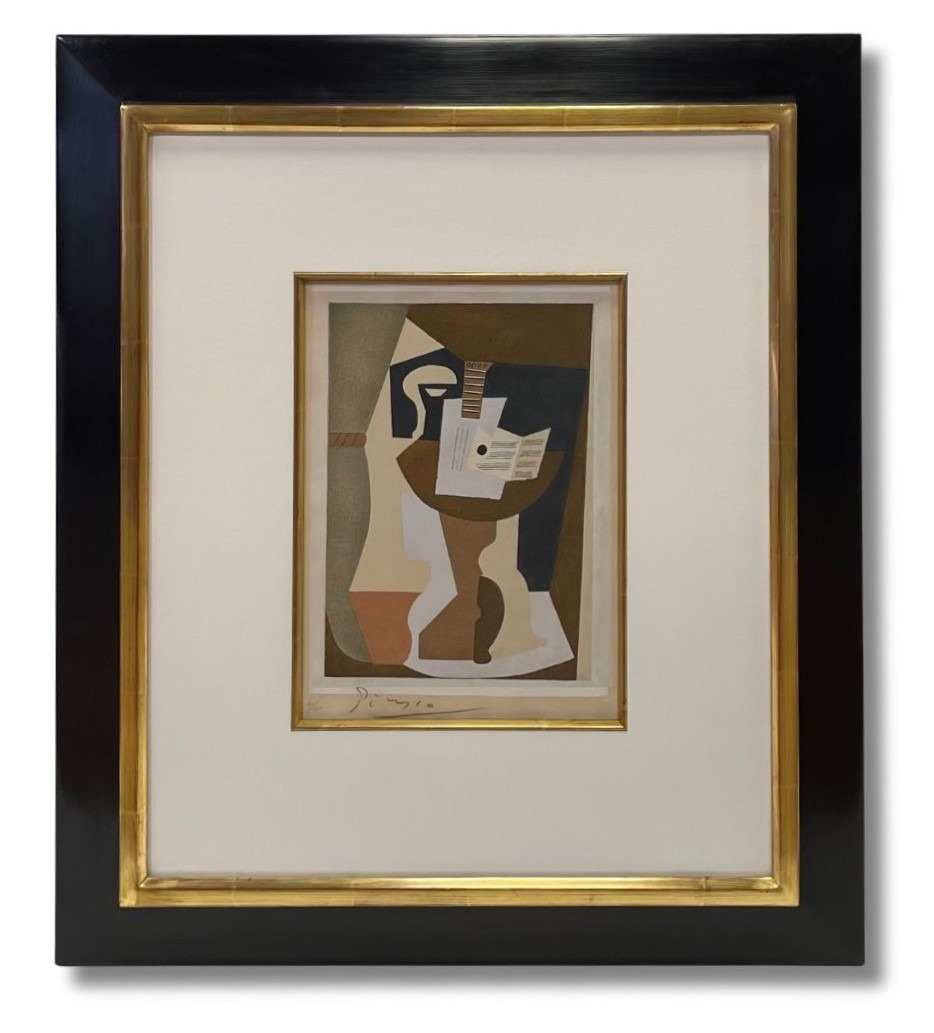
At Artifact, we are committed to preserving and showcasing works of fine art using techniques that honor the artist’s vision and the integrity of the object. A recent project involved the museum-quality framing of Guitare et partition sur guéridon (1920), a pochoir in colors on wove paper by one of the most influential artists of the 20th century, Pablo Picasso.
About the Artist
Pablo Picasso (1881–1973) was a Spanish painter, sculptor, and printmaker whose revolutionary contributions reshaped the course of modern art. Co-founder of Cubism and a prolific innovator across styles and media, Picasso created thousands of works spanning periods of realism, abstraction, surrealism, and beyond. From Les Demoiselles d’Avignon to Guernica, his visual language remains instantly recognizable and endlessly studied. Even in more modest formats like the pochoir, Picasso’s ability to distill rhythm, form, and energy is unmistakable.
About the Work
Guitare et partition sur guéridon (Guitar and Sheet Music on a Pedestal Table) captures the essence of synthetic Cubism with its layered planes, simplified shapes, and vibrant color palette. Created as part of a series of decorative pochoirs, this work exemplifies Picasso’s interest in musical themes, as well as his experimentation with printmaking as a vehicle for design and dissemination.
Museum Quality Framing
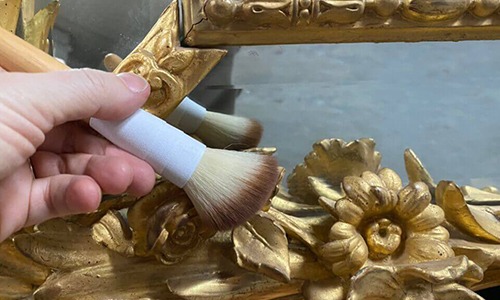
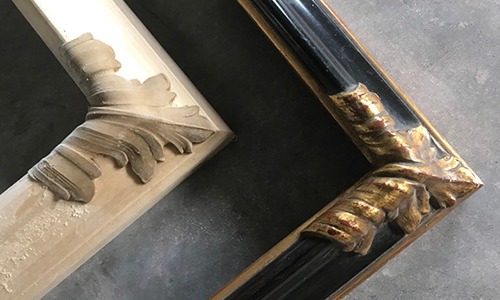
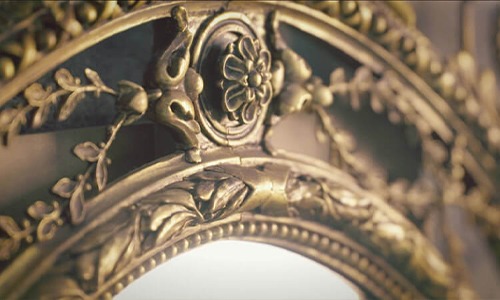
To preserve and elevate this early 20th-century print, our studio crafted a museum-quality custom frame that harmonizes protection with aesthetics. The frame features a finished corner construction, a traditional technique in which corners are joined and finished by hand. The miter joints are obscured by the finish, providing a seamless finish. The inner lip was water gilded in 22k gold leaf, lending a luminous edge that subtly highlights the tonal vibrancy of the pochoir. The gilded finish was hand-rubbed to allow the warmth of the red clay bole to show through, further complementing the print.
The outer panel is black lacquered with a hand-rubbed finish to produce a satin sheen—an understated, modern counterpoint to the gilded sight edge. To ensure the artwork remains protected and visually undistorted, we used Optium Museum Acrylic, which offers 99% UV protection, anti-reflective clarity, and is virtually shatterproof.
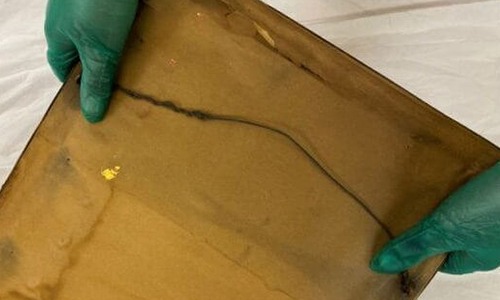
The piece was mounted using an 8-ply 100% cotton ragboard mat, both for depth and archival stability. The sheet was archivally hinged using Asian tissue, and methylcellulose to safely secure the print to a cotton ragboard support. A fluted polypropylene panel was installed for the backboard, ensuring long-term environmental protection while remaining lightweight and inert.
A Timeless Result
This framing approach not only protects the pochoir from environmental and light damage but also presents it in a way that complements its refined geometry and rich coloration. The result is a visually stunning presentation—worthy of a work by Picasso—and a framing treatment that meets the highest conservation standards.
If you have questions about museum-quality archival picture framing, please contact us.
312-344-0331
info@artifactservices.com
Frequently Asked Questions
What is museum-quality framing for a Picasso print?
Museum quality framing is a conservation focused approach designed to protect valuable works of art while presenting them appropriately. For Picasso’s Guitare et partition sur guéridon, the framing package included a handcrafted finished corner frame Optium Museum Acrylic, acid-free cotton ragboard, archival hinging to an acid-free cotton ragboard, and an inert, moisture resistant, protective backboard.
How should a valuable Picasso print be framed?
A valuable Picasso print should be framed with archival, reversible materials that do not permanently alter the artwork. The print should be hinged with conservation-grade materials, supported by 100% cotton ragboard, protected with UV-filtering glazing, and housed in a frame deep enough to prevent contact between the artwork and the glazing.
What is a finished corner frame, and why is it appropriate for fine art?
A finished corner frame is assembled before its decorative surface is applied, allowing the corners and miters to be concealed beneath a continuous hand applied finish. This creates a seamless, refined appearance. For this Picasso print, black lacquer and a 22-karat water-gilded inner lip provided a sophisticated presentation that complements the print’s Cubist geometry and vibrant colors.
Why is Optium Museum Acrylic used when framing valuable artwork?
Optium Museum Acrylic combines exceptional optical clarity with anti-reflective, UV-filtering, abrasion-resistant, anti-static, and virtually shatterproof properties. It helps protect works on paper from damaging ultraviolet light while minimizing distracting reflections. Its lighter weight and resistance to breakage also make it particularly suitable for valuable or irreplaceable artwork.
Are archival framing materials and mounting methods reversible?
Conservation framing is designed to be as safe and reversible as practical. For this Picasso print, the sheet was hinged to a cotton ragboard support using Asian tissue and methylcellulose; a conservation-grade adhesive that can be reversed by a qualified professional. Reversible mounting helps preserve the physical integrity and future treatment options of the artwork.