The Prodigal Son Tending the Swine
1538 Engraving by Hans Sebald Beham
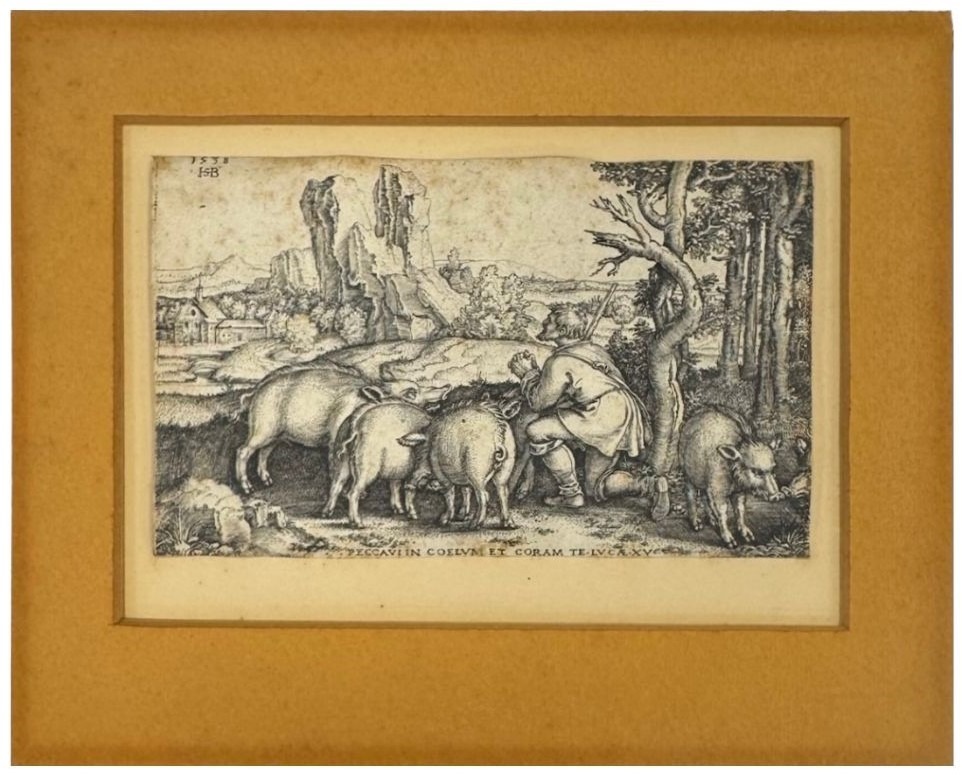
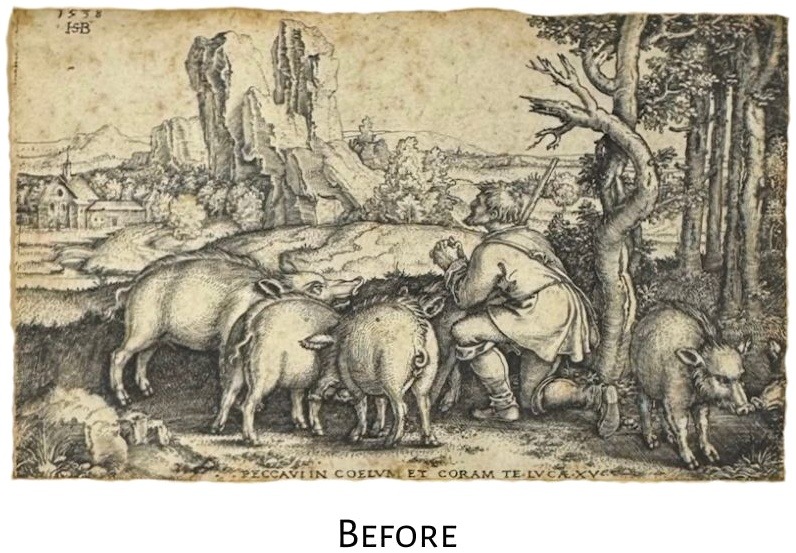
At Artifact, we specialize in museum-quality conservation and the careful preservation of historically significant works on paper. A recent project involved the treatment of a delicate 16th-century engraving, The Prodigal Son Tending the Swine (1538), by German artist Hans Sebald Beham. This intricate black ink engraving on cream laid paper arrived at our Chicago paper conservation studio exhibiting notable foxing, acid burn, and darkening from previous acidic and inferior framing materials. The print was in need of conservation treatment and new archival housing.
About the Artist
Condition on Arrival
The print was housed in a shallow, 4ply, acidic paperboard mat, which had contributed to its degradation over time. Inscribed along the bottom edge was the Latin phrase: “PECCAVI IN COELUM ET CORAM TE LUCAE XV” (“I have sinned against Heaven and in front of you,” Luke 15), grounding the narrative in its biblical origins.
On close examination, the paper exhibited diffuse discoloration, moderate surface dirt, and foxing scattered throughout the sheet. The top edge showed the most concentrated staining, corresponding to areas where tape and hinge materials had been previously applied. These materials had restricted the paper’s natural ability to expand and contract with changes in humidity, resulting in visible undulations.
Conservation Goals and Treatment
Conservation began with gentle surface cleaning on both sides to lift loose dirt. To address the old hinges and tapes at the top verso corners, a methylcellulose poultice was carefully applied and followed by damp swabbing to release the adhesive without disturbing the fibers. The print was then slowly humidified using a Gore-Tex system, allowing the paper to safely rehydrate and expand in a controlled environment.
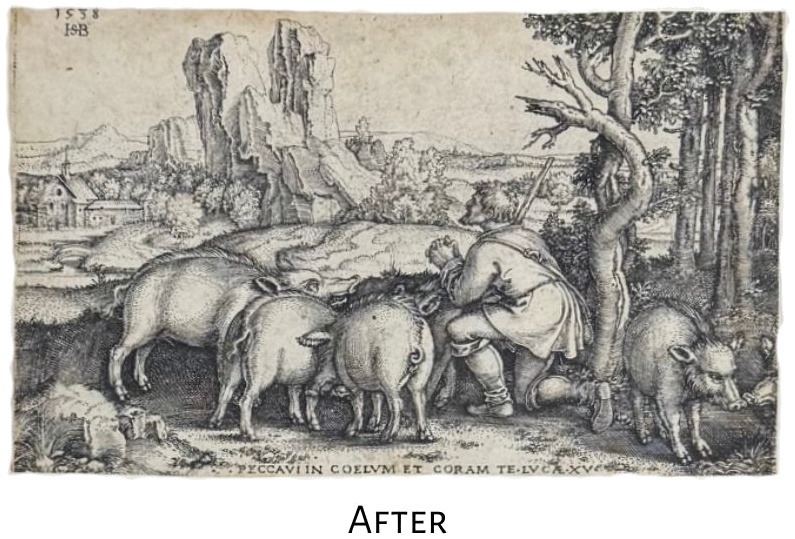
Next, the sheet was blotter-washed with water that had been conditioned to appropriate pH and conductivity levels. As the washing process progressed, the solution was adjusted to be slightly alkaline. With the print still wet, it was placed under a light bank to help gently brighten the sheet.
Following this, residual staining along the top edge was reduced with a targeted foxing treatment. After this local reduction, the print was humidified again and rinsed on a damp blotter. Finally, it was dried under weight, restoring the sheet to a stable, planar state.
Results
Can foxing and acid staining be removed from an antique engraving?
How are 16th-century engravings safely cleaned and conserved?
Conservation of a 16th-century engraving begins with a detailed examination of the paper, printing ink, staining, previous repairs, and mounting materials. Depending on the print’s condition, treatment may include gentle surface cleaning, removal of old adhesives, controlled humidification, blotter washing, targeted foxing reduction, and flattening under weight. All procedures should be selected and performed by a qualified paper conservator.
What causes foxing, acid burn, and discoloration on antique prints?
Foxing and discoloration may result from elevated humidity, environmental pollutants, impurities within the paper, or prolonged contact with acidic mats, backing boards, tapes, and adhesives. Acid burn is often visible where an artwork has touched poor-quality framing materials. Archival housing and stable environmental conditions help limit additional deterioration after conservation.
How should a historic engraving be stored or framed after conservation?
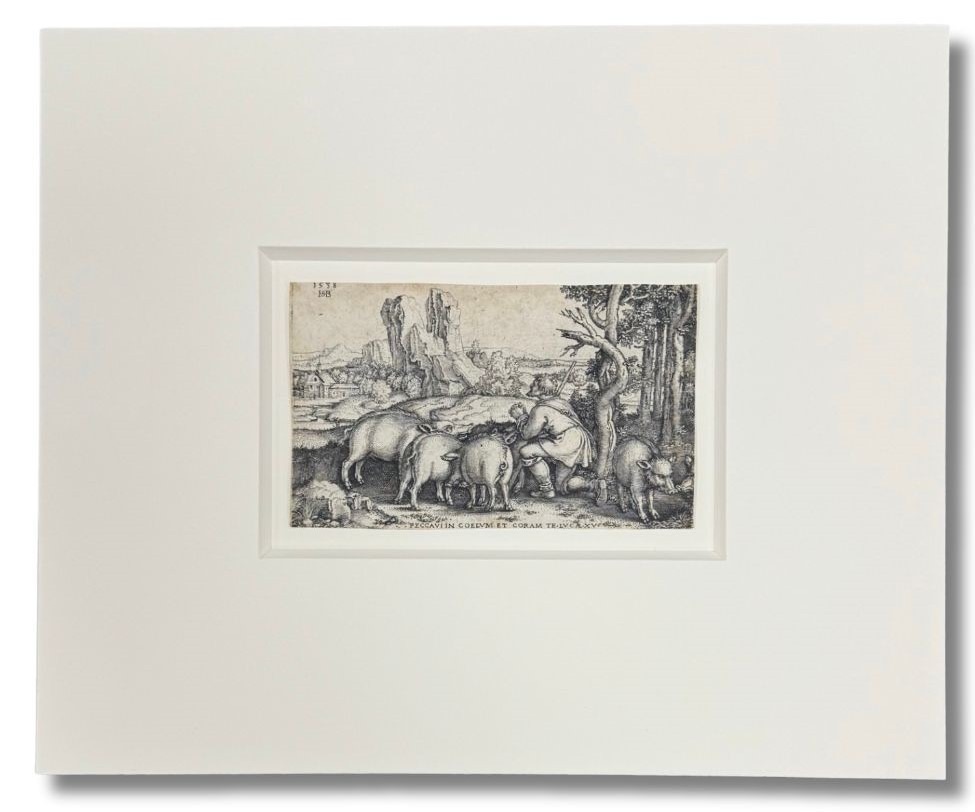
After treatment, a historic engraving should be housed using acid-free, lignin-free, conservation-quality materials. An archival bookmat made from cotton ragboard provides protection while allowing the print to be viewed safely. For display, the work should be archivally hinged and framed with appropriate glazing, backing, and spacing to protect it from direct contact, ultraviolet light, humidity fluctuations, and pollutants.